
Recombinant vs Animal-Derived Collagen: What’s the Real Difference?
Sep
Recombinant vs Animal-Derived Collagen: What’s the Real Difference?
Not all collagen ingredients are created the same way. Here’s how recombinant collagen stacks up against the bovine, marine, and porcine collagen most people are familiar with.
Where Each Type Comes From
Animal-derived collagen is extracted directly from animal tissue: cow hide and bone (bovine), fish skin and scales (marine), or pig skin (porcine). The collagen is broken down through hydrolysis into smaller peptides that can be absorbed by the body.
Recombinant collagen is grown, not extracted. Scientists insert the human gene sequence for collagen into a host cell (commonly yeast), which is then cultured to produce the collagen protein — no animal tissue required.
Structural Accuracy
Animal collagen is structurally similar to human collagen but not identical — there are small sequence differences between species. Recombinant collagen, by contrast, is engineered to match the human collagen sequence precisely, which is why it’s sometimes described as “human-identical.”
- Purity and Consistency
Animal-derived collagen can vary batch to batch depending on the source animal, and carries a small but real risk of contamination or allergenic proteins. Recombinant collagen is produced in a controlled fermentation environment, which allows for tighter quality control and consistent purity from batch to batch. - Allergy and Sensitivity Considerations
People with fish or shellfish allergies need to avoid marine collagen; some people are sensitive to bovine-derived proteins. Because recombinant collagen doesn’t involve animal tissue, it sidesteps many of these common sensitivities — though anyone with specific allergies should still check the full ingredient list. - Environmental and Ethical Factors
Recombinant collagen production doesn’t rely on animal farming or byproducts, which appeals to consumers looking for vegetarian or more ethically-sourced formulations.
Which Should You Choose?
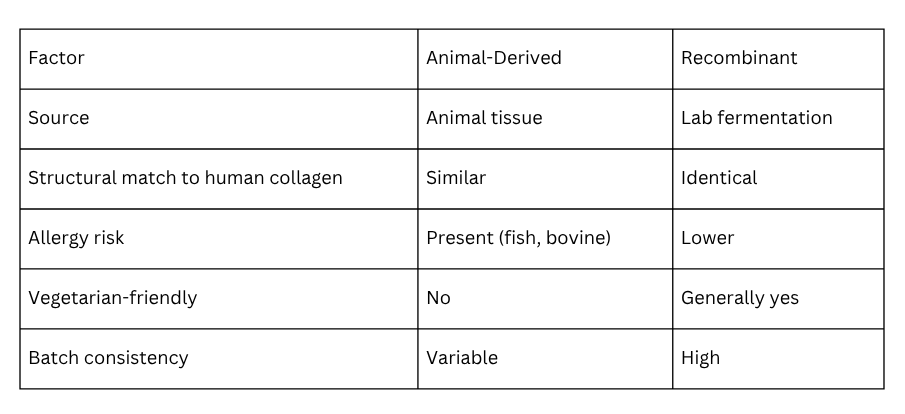
Both forms can support skin and connective tissue health. The choice often comes down to purity preferences, allergy considerations, and whether animal-free sourcing matters to you.
FAQ
Does recombinant collagen work as well as animal-derived collagen? Early research suggests recombinant collagen’s human-identical structure may allow for better recognition and integration by the body, though animal-derived collagen has a longer track record of use in supplements.
Is recombinant collagen more expensive? It can be, due to the more complex production process, though pricing varies widely by brand and formulation.
Can I switch from marine to recombinant collagen? Yes — there’s no medical reason you can’t switch. Many people choose recombinant collagen specifically to avoid marine or bovine sourcing.