
Recombinant vs Marine vs Bovine Collagen: A Complete Comparison

25
Sep
Sep
Recombinant vs Marine vs Bovine Collagen: A Complete Comparison
These are the three collagen sources you’re most likely to see on ingredient labels. Here’s how they actually differ.
Marine Collagen
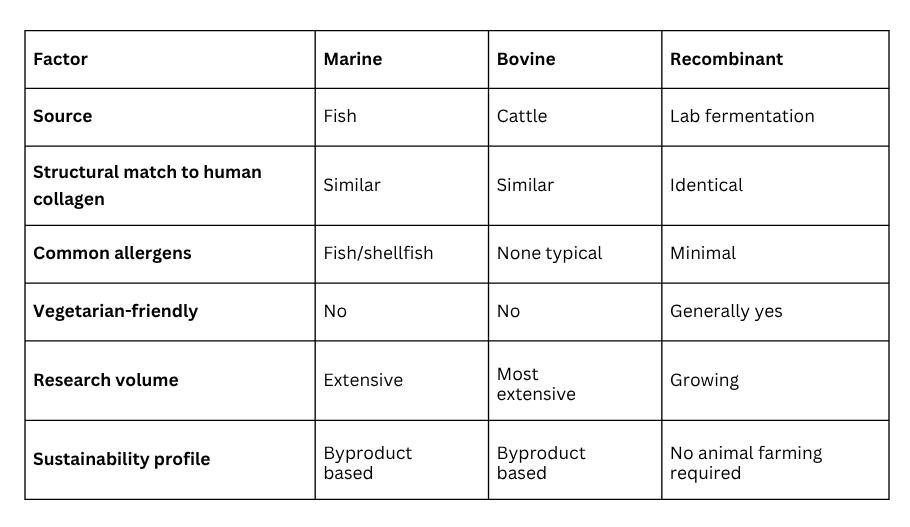
- Source: Fish skin and scales, typically byproducts of the fish processing industry.
- Strengths: Marine collagen has smaller peptide molecules than bovine collagen, which some research suggests may support easier absorption. It’s also a popular choice for people avoiding bovine/mammalian sources for religious or dietary reasons.
- Considerations: Not suitable for people with fish or shellfish allergies. Sustainability and traceability of sourcing varies significantly by supplier.
Bovine Collagen
- Source: Cow hide, bone, and connective tissue.
- Strengths: The most researched and widely used collagen source historically, with the largest body of clinical study data. Typically rich in Type 1 and Type 3 collagen, the two types most relevant to skin health.
- Considerations: Not suitable for vegetarians or people avoiding beef products for religious, ethical, or dietary reasons. Quality and safety depend heavily on the health and traceability of source cattle.
Recombinant Collagen
- Source: Lab-fermented, using a genetically modified host organism (commonly yeast) programmed to produce the human collagen sequence.
- Strengths: Human-identical molecular structure, high purity and batch consistency, no animal tissue involved, and lower allergen risk related to fish or bovine proteins.
- Considerations: Newer to market with a smaller (though growing) body of specific clinical research compared to decades of bovine collagen studies. Production can be more costly, which may be reflected in price.
Side-by-Side Comparison
Which One Is “Best”?
There’s no single universal answer — it depends on priorities:
- Prioritizing decades of research? Bovine collagen has the longest track record.
- Avoiding mammalian sources specifically? Marine collagen is a common choice, if fish allergy isn’t a concern.
- Prioritizing purity, consistency, and animal-free sourcing? Recombinant collagen is designed specifically to address these priorities.
FAQ
- Is recombinant collagen replacing marine and bovine collagen in the market?
It’s a growing category rather than a full replacement — many brands offer recombinant collagen specifically as a purity- and sourcing-focused alternative, while marine and bovine options remain widely available. - Which type absorbs best when taken orally?
All three are typically hydrolyzed into small peptides for oral supplements, which is the primary factor in absorption — the original source matters less once the collagen has been broken down to peptide form. - Can I combine different collagen sources in my routine?
Yes, there’s no known issue with using, for example, an oral bovine collagen supplement alongside a topical recombinant collagen product — they aren’t mutually exclusive.