
Topical vs Oral Collagen: Which Actually Works Better?

Sep
Topical vs Oral Collagen: Which Actually Works Better?
This is one of the most common — and most misunderstood — questions in the collagen category. The honest answer is that topical and oral collagen work differently, not that one is simply “better.”
The Core Problem With Topical Collagen
Collagen is a large protein molecule. Intact collagen molecules, recombinant or not, are generally too large to penetrate through the stratum corneum (the skin’s outer barrier) into the dermis, where the body’s own collagen actually lives. This is basic skin physiology, not a flaw specific to any one product.
So What Does Topical Collagen Actually Do?
Topical collagen products work primarily as:
- Humectants — collagen has water-binding properties that help hydrate the skin’s surface
- Barrier support — a well-formulated topical can help reduce moisture loss and support the skin’s protective barrier
- A delivery vehicle — many topical collagen products are formulated with smaller peptides or complementary actives (like vitamin C or hyaluronic acid) designed to penetrate more effectively
- Improved hydration and barrier function can make skin look plumper and more radiant short-term, even though the topical collagen itself isn’t rebuilding dermal collagen directly.
What Oral Collagen Does Differently
When collagen is ingested, digestion breaks it down into smaller peptides and amino acids, which are absorbed into the bloodstream. Some of these collagen-derived peptides have been shown in clinical studies to act as signaling molecules, prompting the body’s fibroblasts to increase their own natural collagen and elastin production.
This is an indirect mechanism — oral collagen isn’t “delivered” to your skin intact, but it may stimulate your body’s own collagen-building machinery.
Comparing the Two
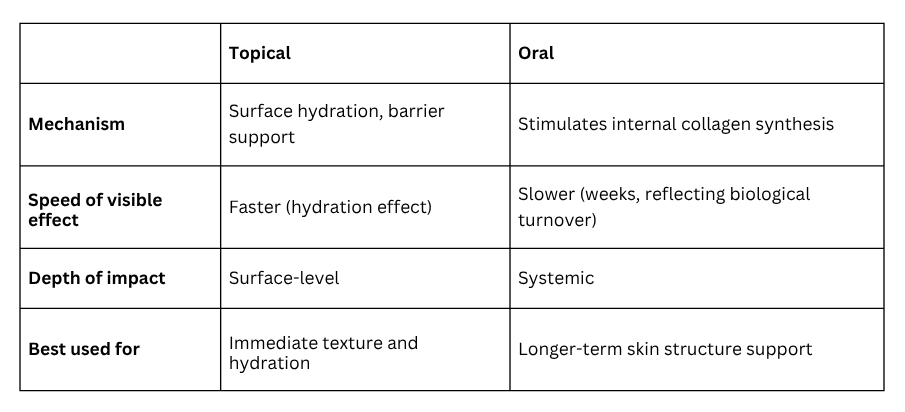
| Topical | Oral | |
| Mechanism | Surface hydration, barrier support | Stimulates internal collagen synthesis |
| Speed of visible effect | Faster (hydration effect) | Slower (weeks, reflecting biological turnover) |
| Depth of impact | Surface-level | Systemic |
| Best used for | Immediate texture and hydration | Longer-term skin structure support |
The Realistic Recommendation
Many dermatologists and researchers suggest that topical and oral collagen aren’t competing strategies — they address different layers of the same problem. A topical product can improve how skin looks and feels day-to-day, while consistent oral supplementation works on a longer biological timeline to support the skin’s own collagen production.
FAQ
- Can topical collagen replace oral collagen supplements?
No — they work through different mechanisms and aren’t interchangeable; using both addresses surface and internal factors respectively. - How long before oral collagen shows results?
Most clinical studies measure meaningful changes after 8-12 weeks of consistent daily use, reflecting the natural collagen turnover cycle. - Is topical collagen a waste of money if it can’t penetrate skin?
Not necessarily — hydration and barrier support have real, measurable benefits for skin appearance, even without deep dermal penetration.
Topical vs Oral Collagen: Which Actually Works Better?
This is one of the most common — and most misunderstood — questions in the collagen category. The honest answer is that topical and oral collagen work differently, not that one is simply “better.”
The Core Problem With Topical Collagen
Collagen is a large protein molecule. Intact collagen molecules, recombinant or not, are generally too large to penetrate through the stratum corneum (the skin’s outer barrier) into the dermis, where the body’s own collagen actually lives. This is basic skin physiology, not a flaw specific to any one product.
So What Does Topical Collagen Actually Do?
Topical collagen products work primarily as:
- Humectants — collagen has water-binding properties that help hydrate the skin’s surface
- Barrier support — a well-formulated topical can help reduce moisture loss and support the skin’s protective barrier
- A delivery vehicle — many topical collagen products are formulated with smaller peptides or complementary actives (like vitamin C or hyaluronic acid) designed to penetrate more effectively
- Improved hydration and barrier function can make skin look plumper and more radiant short-term, even though the topical collagen itself isn’t rebuilding dermal collagen directly.
What Oral Collagen Does Differently
When collagen is ingested, digestion breaks it down into smaller peptides and amino acids, which are absorbed into the bloodstream. Some of these collagen-derived peptides have been shown in clinical studies to act as signaling molecules, prompting the body’s fibroblasts to increase their own natural collagen and elastin production.
This is an indirect mechanism — oral collagen isn’t “delivered” to your skin intact, but it may stimulate your body’s own collagen-building machinery.
Comparing the Two
The Realistic Recommendation
Many dermatologists and researchers suggest that topical and oral collagen aren’t competing strategies — they address different layers of the same problem. A topical product can improve how skin looks and feels day-to-day, while consistent oral supplementation works on a longer biological timeline to support the skin’s own collagen production.
FAQ
- Can topical collagen replace oral collagen supplements?
No — they work through different mechanisms and aren’t interchangeable; using both addresses surface and internal factors respectively. - How long before oral collagen shows results?
Most clinical studies measure meaningful changes after 8-12 weeks of consistent daily use, reflecting the natural collagen turnover cycle. - Is topical collagen a waste of money if it can’t penetrate skin?
Not necessarily — hydration and barrier support have real, measurable benefits for skin appearance, even without deep dermal penetration.