
Topical Type 3 Collagen: Mechanism of Action
Sep
Topical Type 3 Collagen: Mechanism of Action
Because Type 3 collagen is the body’s first-response repair material after UV-induced micro-damage, the skin’s own resynthesis process depends on having the right local conditions and raw materials at the site of damage — the epidermis and upper dermis where UV-triggered inflammation and MMP activity are concentrated. This is the basis for applying topical Type 3 collagen for sun-damaged skin directly onto sun-exposed skin, rather than relying only on prevention or internal synthesis.
A well-formulated topical collagen for sun recovery, applied directly to skin after sun exposure, works on a few levels:
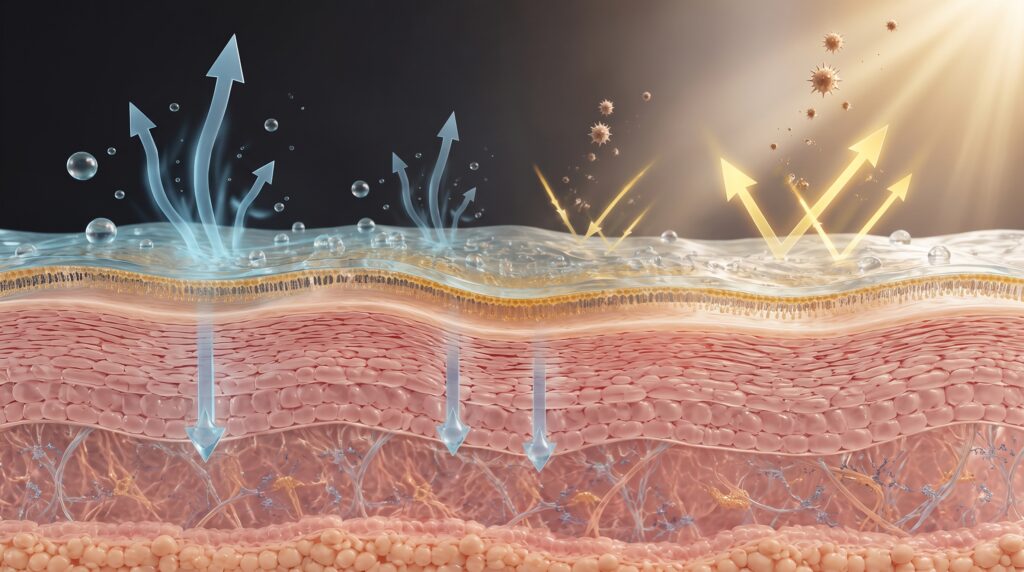
- Barrier support and moisture retention: Collagen is a large, humectant-rich molecule. Applied topically, it sits on and within the upper layers of the stratum corneum, forming a hydrating film that reduces transepidermal water loss — important because UV-stressed skin loses moisture faster, which itself impairs the skin’s repair capacity.
- Peptide-level signaling: Collagen applied topically doesn’t fully penetrate as an intact structural fiber the way collagen made inside the dermis does — the molecule is generally too large to cross the skin barrier whole. However, the smaller collagen fragments and peptides in a well-formulated topical product can reach the upper dermis and act as signaling molecules, helping to cue local fibroblasts toward repair activity at the surface level.
- Soothing the post-UV inflammatory environment: UV exposure leaves skin in an oxidative, inflamed state, which is exactly when MMPs are most active and breaking down existing collagen. A topical layer that calms and hydrates this environment can help reduce the conditions that accelerate further collagen loss, even though it isn’t rebuilding deep dermal collagen directly.
In short, topical Type 3 collagen is best understood as supporting the skin’s surface-level recovery environment after UV exposure — reinforcing hydration, buffering irritation, and delivering peptide signals — rather than replacing deep structural collagen, which the body must still rebuild on its own.